Destination Level
These settings pertain to the tank or pond being filled by the pump station (image 1.1). They help the system determine when water demand is active — when the water level drops below a set point — and when demand has decreased — when the level reaches a specified upper limit. This allows the station to operate efficiently, filling only as needed based on the target water levels.
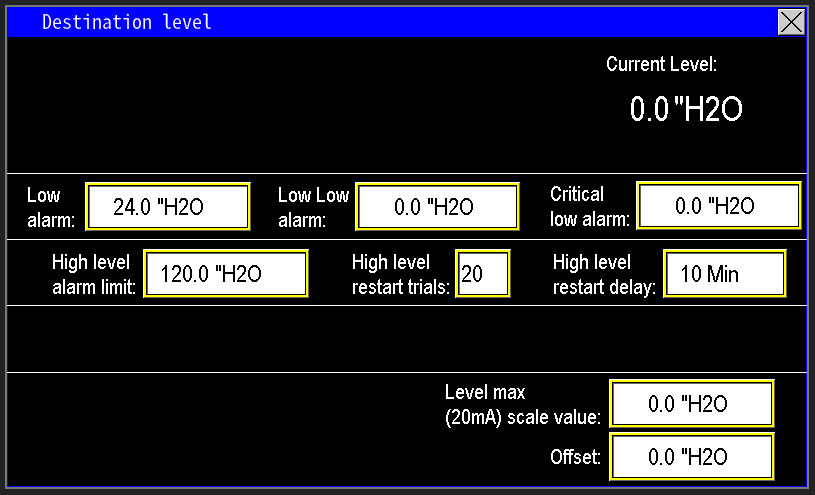
1.1 Destination Level Settings
Low Level alarm limits.
The level alarms in the Destination Level settings serve as notifications to alert operators of potential issues with the water level in the tank or pond being filled. These alarms do not shut down the pump station but help monitor the situation and allow for proactive responses (image 1.2).
There are three alarm levels:
- Low Level: Indicates the water level has dropped below a threshold where the system is still operating normally but needs attention soon.
- Low Low Alarm: Signals the water level is lower than ideal and could indicate a developing problem that should be investigated.
- Critical Low Alarm: Represents an urgent condition where the water level is at the lowest operational point. At this stage, there could be water shortages affecting the system's operation. Immediate action is recommended to identify possible leaks, supply issues, or upstream problems between the tank and pump station.
Properly setting these levels enables proactive management to prevent water shortages and ensure the system functions as intended.

1.2 Low level alarms
High Level alarm limit, restart trials, and delay
The station will fault when the water level reaches the High Level threshold to prevent overfilling the tank (image 1.3). This fault is temporary; once the water level drops below the High Level threshold, the restart delay begins.
In the example, with a 10-minute delay, the PLC will wait 10 minutes before attempting to restart the pumps, provided all other conditions are met. The station can repeatedly fault and attempt restarts up to the configured number of restart trials. If the station exceeds these trials—i.e., it restarts the specified number of times without resolving the underlying issue—it will enter a permanent fault state, requiring manual reset.
Once the underlying problem (such as a leak, valve issue, or sensor fault) is identified and corrected, pressing the reset button will clear the fault and allow the station to restart normal operation.

1.3 High level alarm and restarts
Transmitter Scaling
To ensure accurate level readings, match the maximum 20mA output value on the display to the transmitter’s maximum range (image 1.7). Check the transmitter’s maximum rated level and input that value into the Level Max (20mA) scale setting.
The offset setting accounts for the physical distance between the bottom of the tank and the bottom of the transmitter. This allows for proper installation without the transmitter being submerged in mud or debris that can collect on the bottom, while accurately measuring the actual water level including the space below the transmitter.
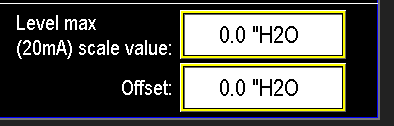
1.7 Transmitter scaling
Special Note
When the station is filling a tank, the operational approach depends on the system configuration:
Pressure-Based Fill (Standard Operation):
Most stations use pressure setpoints (Image 1.8) to fill the tank. As the tank fills, pressure approaches the setpoint, flow slows, and the station transitions to sleep mode once full. This normal operation relies on pressure control to gauge the fill level indirectly.
Destination Fill System:
When configured as a destination fill system (Image 1.7), the primary goal shifts from pressure to actual level. The system monitors the tank level via a level transmitter. Filling only occurs when the level drops to the Cut-In level (e.g., 24" of water, Image 1.9).
Once the level reaches the Cut-Out level (e.g., 120" of water), the station stops and enters sleep mode, waiting for the level to drop again before resuming.
During fill, the pump operates under level PID control until the maximum level is reached, ensuring precise level management and preventing overfill. The station will not return to sleep until the Cut-Out level is achieved, maintaining an accurate and controlled fill cycle based purely on tank level.
 1.7 System Type Fill |
 1.8 System Type Normal |
 1.9 Level cut in and out |